




Friction and Wear Characteristics
The self-lubricating performance of EP series plastic bearings is achieved by incorporating solid lubricants and functional fibers into the base material via modification technology. Solid lubricants reduce the friction coefficient, which is also affected by working load, operating speed and shaft surface roughness. Generally, the friction coefficient decreases with the gradual increase of working load and rises as the operating speed increases.
Fine wear occurs in any self-lubricating bearing under loaded operation, and EP series bearings are no exception. During the start-up phase, fine wear triggers the exudation of lubricant, which gradually fills the friction surface and transfers onto the mating shaft surface. Once the working area of the mating shaft is covered by lubricant, a thin lubricating separating film forms. At this point, the initial wear of the bearing nearly ceases. In subsequent long-term operation, the bearing wear rate is greatly reduced and remains stable.
Relationship between Load, Temperature and Speed
The allowable load of a bearing decreases gradually as its operating temperature rises. When the operating temperature exceeds the maximum service temperature, the bearing’s load capacity drops sharply. The bearing load also reduces with increasing operating speed. Higher speed leads to a gradual rise in frictional heat of the bearing, and the load decreases accordingly as temperature continues to climb.
PV Value and Correction Factor
PV value is an important indicator for evaluating the comprehensive performance of plain bearings. The actual PV value is inversely proportional to bearing service life. Therefore, a relatively low PV value is recommended in design to ensure longer bearing service life.
Although EP series plastic bearings are specially designed for dry friction applications, they feature good compatibility with most common lubricants. Applying lubricant during the bearing start-up phase can improve start-up performance and shorten the running-in period. The bearing load capacity will increase significantly when lubricant is present.
Friction Coefficient and Shaft Surface Roughness
The friction coefficient is correlated with the surface roughness of the shaft. Obviously, friction coefficient is affected by many different factors. If the shaft surface is too rough, wear will increase. Minor surface irregularities cause mutual abrasion between the shaft and bearing, forming the friction interface.
On the contrary, an overly smooth surface tends to cause adhesion, where the two surfaces stick to each other. A larger force is required to overcome this adhesion, which increases the friction coefficient.
A large difference between static and dynamic friction coefficients will increase the tendency of surface adhesion, which may lead to stick-slip motion and loud sharp noise. After repeated cycles, the noise tends to decrease and the rough shaft surface becomes smoother. Therefore, stick-slip (low-speed motion) should be avoided in application. Optimizing the shaft surface roughness is essential to maintain consistent base support. SAVI recommends shafts with surface roughness Ra0.2~Ra0.8, hardness above HRC35 and hard chrome plating to prevent shaft abrasion by bearings.
Bearing Wear
Bearing wear resistance is affected by many factors, making it difficult to accurately predict bearing wear and service life. Multiple tests show that the main influencing factors include load, speed, motion type, bearing material and roughness, environmental dust, and type of external lubricant.
Generally, bearing wear resistance decreases gradually with rising load, speed and temperature. Wear resistance can be multiplied if external lubricant is supplied. If dust enters the bearing, special wear problems will occur. In such cases, plain bearings can obviously extend the service life of machinery and systems. The excellent wear resistance and self-lubricating properties of the material greatly prolong bearing service life. Since there is no oil or grease on the bearing surface, dirt particles are less likely to adhere. Most dust particles will shed without potential damage to the bearing.
However, if hard particles enter the bearing interface, the plain bearing can embed them into its surface. Even with accumulated dust, operation can remain at an optimal level. Nevertheless, not only hard particles can damage shafts and bearings. Soft particles such as fabric scraps or paper debris can also accelerate wear. Under such conditions, the dry-running and dust-resistant capability of plain bearings takes effect, helping enterprises cut costs.
Tolerances and Measurement System
The mounting dimensions and tolerances of SAVI plain bearings depend on material type and wall thickness. Water absorption and thermal conductivity are also critical properties for each material. Plain bearings with low water absorption can be designed with tighter tolerances. Thicker bearing walls require larger tolerances. For this reason, SAVI plain bearings are available in different tolerance grades. Within these tolerances, SAVI plain bearings installed per recommended standards can operate within the permitted temperature range and at humidity up to 70%. We can provide application consultation to help you properly use the bearings for scenarios with higher air humidity or underwater service.
Dimension Measurement Method for EP Series Bushings
The plain bearing is pressed into an H7 tolerance bore. This interference press-fit ensures bearing positioning, and the inner diameter tolerance of the plain bearing is formed during pressing. A go/no-go gauge is recommended for measuring the bearing inner diameter.
The go gauge end shall pass through the bearing inner diameter smoothly. The no-go gauge end shall not pass through.
Bearing Installation
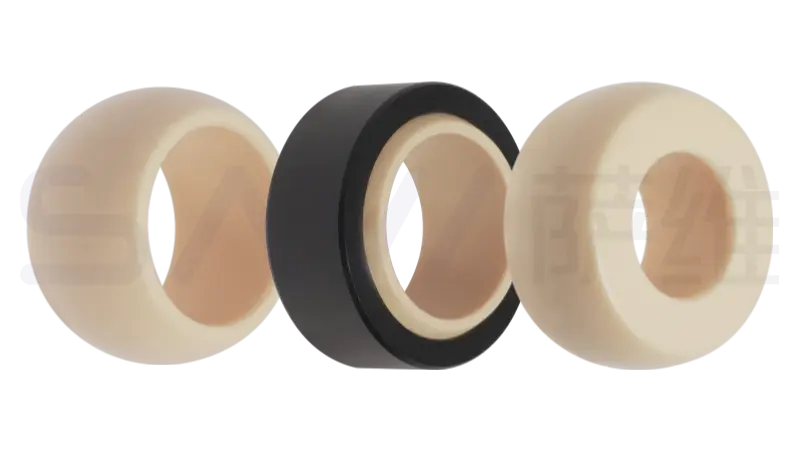
SAVI EP bearings are press-fit bearings. Their inner diameter will adjust only after being pressed into a properly machined housing bore (H7) with recommended tolerances. One end of the housing bore must be chamfered at 25° to prevent scratching the outer diameter during pressing. A stepped mandrel shall be used for slow press fitting. Direct striking on the end face is forbidden, as it may cause deformation and dimensional deviation. Before press fitting, the bearing inner diameter may be up to 2% larger than the nominal size. The interference fit guarantees secure bearing installation and restrains axial and radial movement. The housing bore must be machined to the recommended tolerance (usually H7) with a smooth and flat surface. A flat-headed press rod can be used during pressing. Locating pins shall NOT be used, as they may damage the bearing or enlarge the inner diameter