








| Material Properties | Unit | SF-10 |
|---|---|---|
| Max Load - Static Load | N/mm² | 250 |
| Max. Load – Low-speed Operation | N/mm² | 140 |
| Max. Load – Rotary & Oscillating Motion | N/mm² | 60 |
| Max PV (Dry Friction, Intermittent) | N/mm² × m/s | 3.6 |
| Max PV (Dry Friction, Continuous) | N/mm² × m/s | 1.8 |
| Operating Temperature | ℃ | -195/+280 |
| Friction Coefficient | μ | 0.03~0.20 |
| Max Linear Vel. (Dry Friction) | m/s | 2 |
| Max Linear Vel. (Fluid Lubrication) | m/s | >2 |
| Thermal Conductivity | W/(m·K) | 42 |
| Linear Expansion Coefficient | K⁻¹ × 10⁻⁶ | 11 |
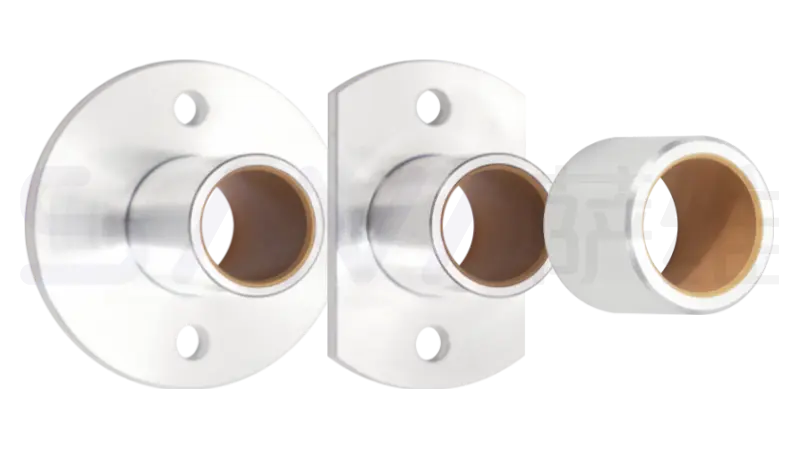
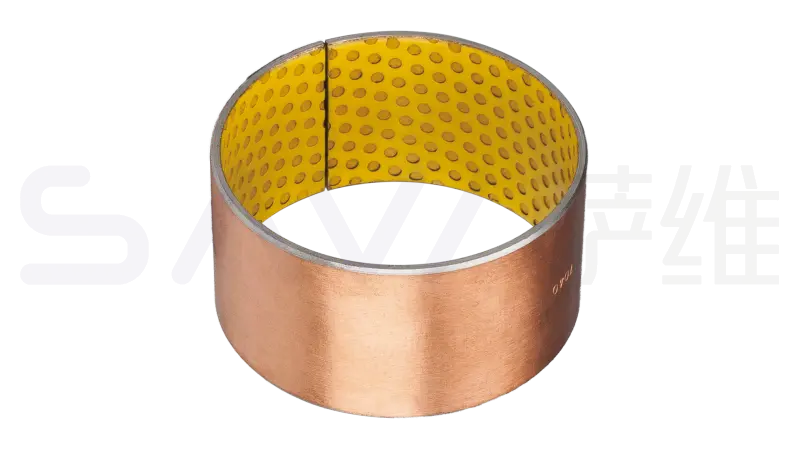
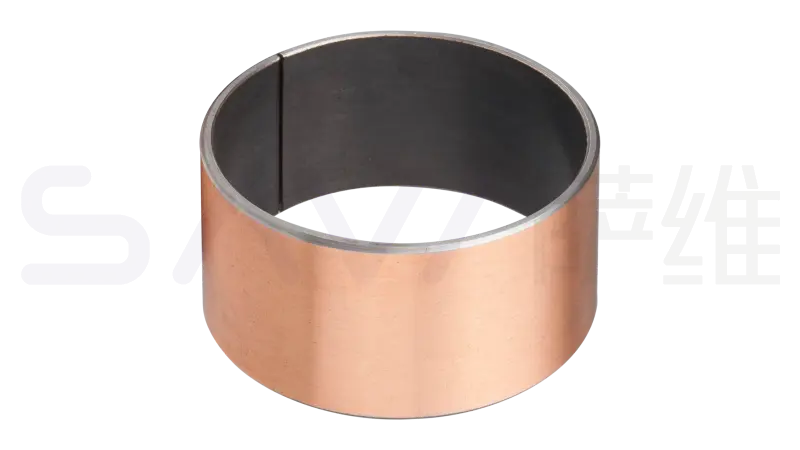
The mixture of PTFE and fibers with a thickness of 0.01‑0.03 mm can form a favorable transfer film to protect the mating shaft and endow the bearing with self‑lubricating performance.
Copper powder layer: 0.20‑0.35 mm. It features high load‑bearing capacity and wear resistance. Its good thermal conductivity dissipates heat generated during bearing operation in a timely manner. The composite material penetrates into the gaps between copper powder particles to improve bonding strength.
Low‑carbon steel, delivers good load‑bearing performance and heat transfer function.
Copper‑tin electroplated layer: 0.002 mm for enhanced corrosion resistance.